More Information
Article Highlighting Impact of Accessible Archives
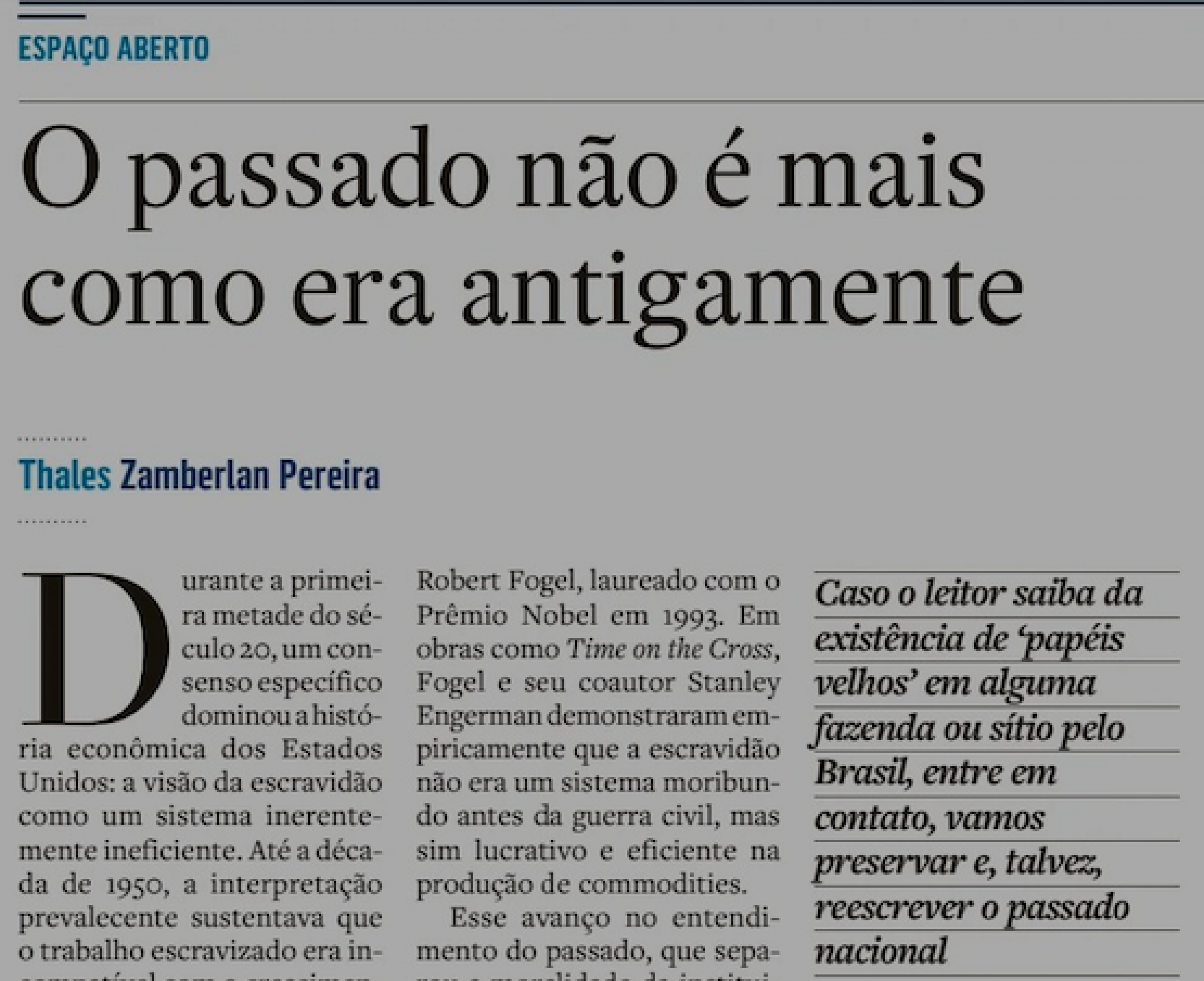
Dr. Thales Zamberlan Pereira published an article about one of MEAP’s first Regional Grants: (Ac)counting the countryside: forestry, rural management & the coffee economy of Southeastern Brazil (1890-1990)(opens in a new tab). The article, published in O Estado de São Paulo in Brazil (January 10, 2026), highlights how the work of archival preservation and data collection related to São Paulo’s coffee economy has enabled a shift in historical understanding of enslaved labor in Brazil.
“The past is no longer what it used to be”
Thales Zamberlan Pereira
Professor of Economic History at the São Paulo School of Economics (FGV-EESP) and co-author of “Adeus, senhor Portugal”, com Rafael Cariello.
in O ESTADO DE S. PAULO
Saturday, January 10, 2026
Open Space
During the first half of the 20th century, a specific consensus dominated U.S. economic history: the view of slavery as an inherently inefficient system. Until the 1950s, the prevailing interpretation held that enslaved labor was incompatible with economic growth.
The implications of this view were politically decisive. If the system were in fact unprofitable, economic logic suggested that it would disappear naturally over time. From this perspective, the Civil War (1861–1865) ceased to be an imperative to end slavery and came to be interpreted instead as a political miscalculation — an unnecessary destruction of lives to end a regime already doomed by its own economic obsolescence.
This narrative was challenged and altered by the rise of “cliometrics,” the application of economic theory and quantitative methods to history. The leading figure in this revision was Robert Fogel, who won the Nobel Prize in 1993. In works such as Time on the Cross, Fogel and his co-author Stanley Engerman demonstrated empirically that slavery was not a dying system before the Civil War, but rather a profitable and efficient one in commodity production.
This advance in understanding the past — which separated the institution’s morality from its economic viability — was only possible through a massive effort of data collection that allowed the past to be analyzed in disaggregated form. The fundamental empirical basis came from the work of William Parker and Robert Gallman, who explored the 1860 U.S. census and assembled comprehensive microdata on agricultural production and population composition from 5,228 farms in the main cotton-growing counties of the South.
The structure and richness of this database became a central resource for investigations into agricultural economics and labor markets in the pre-Civil War period. These analyses indicated that the abolition of slavery would not result from market failures, but would require the direct and violent intervention of the Civil War.
Brazilian historiography on slavery went through a similar revision. The current consensus holds that the system remained profitable until its dismantling, driven fundamentally by the political pressure of the abolitionist movement. However, unlike the United States, Brazil faces a critical shortage of disaggregated evidence.
The central obstacle lies in the nature of Brazil’s first censuses (1872 and 1920), which provide only municipal-level aggregates, lacking the granularity of American records. This gap prevents precise analyses of how farms operated during the transition from enslaved to free labor. Vital questions remain open, such as the true economic condition of free and formerly enslaved Brazilian workers, their efficiency compared with immigrants, and the evolution of Brazilian agricultural productivity.
In the absence of detailed census data, the alternative has been primary archival work. A pioneering effort, coordinated by Bruno Witzel (USP) and Leonardo Gardenal and funded by the Endangered Archives Programme (MEAP) of the University of California, Los Angeles (UCLA), digitized the records of the Ibicaba Plantation, the historic property of Senator Nicolau Vergueiro. Although a single plantation is insufficient to rival the Parker-Gallman sample, the project signals a new methodological path.
In this sense, a new initiative coordinated by the São Paulo School of Economics of the Getulio Vargas Foundation (FGV-EESP), together with the same UCLA program, seeks to expand the empirical base by creating new archives and digitizing five new collections. These include the large São Paulo plantation Santa Gertrudes, the former colonial settlement of Cascalho, the small rural property Casa Feltrin, and the Edmundo Navarro de Andrade State Forest — the former forestry station of the Paulista Railroad Company (Fepasa).
These new data will allow classic questions of economic history to be revisited and open new historiographical perspectives. It will be possible to investigate the presence of the Black population in São Paulo’s coffee economy after abolition and to compare the productivity of Brazilian workers (both white and Black) with European immigrants in the 20th century. In addition, the data will clarify differences in working hours and real wages between laborers on large plantations, smallholders, and residents of colonial settlements, as well as the evolution of nominal wages and variations in consumption baskets outside major urban centers.
This article therefore ends with an appeal. The reconstruction of this history depends on the preservation of private documents, often scattered or forgotten. If the reader knows of the existence of “old papers” on any farm or rural property in Brazil, get in touch — let us preserve them and perhaps rewrite the national past.
Translated by Bruno Witzel (January 2026)